
Winning an international scholarship is not about luck. It is a strategic, disciplined process. Think of it as a campaign, and today I am going to walk you through every phase of that campaign, from where you stand right now to the moment you receive that acceptance letter.
Let me start with the full roadmap, then we will go deep on each step.
Phase 1 – Self-Assessment: Know Yourself Before You Apply
This is the foundation of everything. Most students skip this step and apply randomly; that is the fastest road to rejection.
Ask yourself these critical questions:
Academic standing. What is your GPA or equivalent? What are your strongest subjects? Are your grades in an upward or downward trend? Scholarship committees examine trajectories, not just snapshots.
Nationality and citizenship. Many scholarships are country-specific; Chevening (UK) targets specific nationalities, Fulbright (USA) has bilateral agreements, and DAAD (Germany) prioritizes developing-country applicants. Knowing your nationality profile opens or closes specific doors.
Field of study. Are you in STEM, humanities, law, medicine, public policy, or agriculture? Many scholarships are sector-specific. The Gates Cambridge, for instance, is open to all disciplines but heavily values social impact. The Japanese MEXT scholarship favors technical fields.
Career ambitions. The strongest scholarship applications articulate a clear, credible life mission. Committees fund people, not just grades. Define your “why”; what problem do you want to solve in the world, and how does this scholarship advance that mission?
Your unique value proposition. What makes you different from the other 10,000 applicants? Community service? A startup? A published paper? A groundbreaking project? Identify your anchor story: the single most compelling thing about your journey.
Phase 2 – Research and Targeting: Quality Over Quantity
How to research strategically:
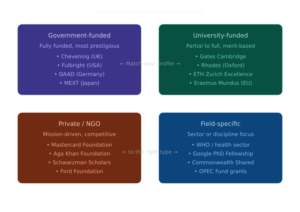
Use scholarship databases, “Ladoscholar.com” or any other scholarship database that’s preferable for you. Most governments publish their scholarship programs on official embassy websites, but we bring them right at your doorstep with just one search. Talk to us about the scholarships you are targeting, or ask any alumni you know about the scholarship. Their insider knowledge is irreplaceable.
The targeting rule: Apply to any number of scholarships as you wish, but make each application exceptional. Submitting 30 rushed applications is far less effective than 4 deeply tailored ones.
The fit matrix: For each scholarship, ask: Does my GPA meet the threshold? Does my nationality qualify? Does my field align? Does my career vision match the scholarship’s mission? Only apply when you score yes on all four.
Phase 3 – Profile Building: Create the Candidate They Cannot Ignore
Think of this as building your product before you market it.
Academic excellence. Academic excellence means presenting a full intellectual portrait, not just a GPA. Committees look at six things: your grades and their trend over time; the rigor of courses you chose; academic awards and distinctions; research engagement and contributions; intellectual curiosity beyond the classroom; and faculty relationships strong enough to generate specific, detailed recommendation letters. A modest GPA can be offset by strength in the other five, and a high GPA with nothing else is rarely enough to win.
Research and publications. Even one undergraduate research project or co-authored paper dramatically strengthens a STEM or social science application. Volunteer with professors, assist with fieldwork, write for peer-reviewed journals, or contribute to recognized academic blogs.
Leadership experience. Scholarship committees want agents of change, not passive students. Lead clubs, found organizations, run community initiatives, and chair student bodies. Document every leadership role with measurable outcomes. “Led a team of 20 that raised $15,000 for school infrastructure” is far stronger than “participated in volunteer work.”
Community impact. Especially for NGO-funded and government scholarships, community service is not optional; it is central. What problem in your community have you worked to solve? This becomes the anchor of your personal statement.
International exposure. Exchange programs, international conferences, multilingual abilities, and cross-cultural projects all signal readiness to thrive in a global environment.
Timeline tip: If you are 12–24 months away from applying, this is your profile-building window. Use it intentionally.
Phase 4 – Application Documents: The Art of Telling Your Story
This is where most scholarships are won or lost.
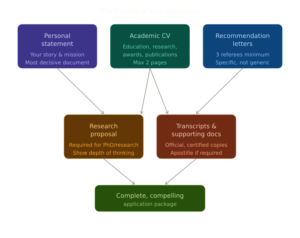
The personal statement (also called statement of purpose or motivation letter) is the single most decisive document. Here is how to write one that wins: How To Write A Winning Scholarship Essay 2026
Open with a compelling hook – a real story, a defining moment, a vivid scene. Do not start with “My name is…” or “I have always been passionate about…” – those are the two most common openers and committees have read them a million times.
Structure it around three pillars: Who you are (your background and the challenge or opportunity that shaped you), What you have done (concrete evidence of your capabilities and impact), and Where you are going (your specific career goal and how this scholarship uniquely enables it). The scholarship should feel indispensable to your story, not interchangeable with any other.
Address the specific criteria of each scholarship directly. Chevening wants future leaders who will return and serve their countries. The Gates Cambridge wants people committed to improving the lives of others. Tailor your essay to each one.
Recommendation letters should come from people who know your work deeply, a research supervisor, a professor whose course you excelled in, or a professional supervisor if you have work experience. Give your referees a briefing document: your CV, the scholarship’s criteria, and specific examples of your work they can reference. Never ask for a “generic” letter.
Your CV for scholarships should follow academic formatting, education first, then research and publications, awards, leadership, and community service. Remove anything that does not directly strengthen your case.
Phase 5 – Exam Preparation: Meet Every Benchmark
Most scholarships have mandatory language and aptitude score requirements. Treat these as non-negotiable gates you must pass before anything else.
English language proficiency: IELTS (commonly 6.5–7.5 overall) or TOEFL (90–110 internet-based) is required by most English-language programs. Begin preparation at least 4–6 months in advance. Take official practice tests, work with a tutor if needed, and retake the exam if your score is below the threshold.
Aptitude tests: The GRE (Graduate Record Examination) is required for most US-bound scholarships. GMAT is needed for business programs. Some European scholarships require proof of academic equivalence through institutional exams.
Subject-specific tests: Medicine requires MCAT in the US or UCAT in the UK. Law school in the US requires the LSAT. Research the exact requirements for each program you are targeting.
Strategic advice: Do not submit any application with a score below the stated minimum; it will be automatically screened out. Strong language scores also signal seriousness and international readiness to the committee.
Phase 6 – Submission and Follow-Up: Execute with Precision
The best application submitted one day late is a failed application. Scholarship committees are rigid about deadlines, with no exceptions.
Build a master tracker. Create a spreadsheet listing every scholarship you are applying to, its deadline, required documents, portal login details, and status. Review it weekly.
Apply early. Most portals experience technical issues in the final 48 hours before deadlines. Submit at least one week early for major applications. This also gives you time to notice any missing documents.
Proofread obsessively. Have at least two trusted people, ideally one who knows your field and one who does not, read every essay. Grammatical errors and factual mistakes signal carelessness to reviewers.
Confirm receipt. Always ensure you receive a confirmation email or portal notification that your application was submitted successfully. Screenshot and save it.
Follow up if invited to. If a scholarship allows applicants to submit additional materials or updates after submission, use that window strategically: a new publication, a fresh leadership achievement, an award.